QuillBot lost a fifth of its traffic. Jasper lost nearly half and now sells AI agents.
QuillBot’s estimated website visits fell 20% from May to September 2026 and Jasper’s 46%. Jasper’s homepage now leads with AI agents for marketing.
Table of Contents
QuillBot’s website had 20% fewer estimated visits in September 2026 than in May, and it had company: 15 of the 16 paraphrasing sites we could measure lost visits. The median one lost 29%, against 13.5% for the median site of the size 15 of them are. Jasper’s site lost 46% over the same months, and its homepage, read on November 19, is titled “Put AI agents to work for marketing”. Three more names that used to mean AI copywriting lead with something else too: Writesonic (down 32%) with tracking what AI assistants say about a brand, Copy.ai (down 21%) with a sales and marketing platform, and Rytr (about level, down 2%) with an assistant that drafts client follow-ups. United States searches for “ai copywriting” fell from 1,900 in May 2025 to 320 in May 2026.
These are two findings, not cause and effect. Falling alone is not one: about two-thirds of all the sites we track lost visits over these months, as did 44 of the 59 writing tools we measured. The paraphrasers did worse than that. The former copywriters are a different finding: what they sell has changed.
A visit here is a visit to a website. QuillBot, Grammarly and others also work as browser extensions, keyboards and apps, so these figures count sign-ups and web editors, not use.
The reason to look now: Superhuman, the company that changed its name from Grammarly in October 2025, announced on November 19 that its Go assistant is coming to its document and email products. Our histories end in September and say nothing about it.
Paraphrasers fell further than sites their size

Eleven of the 16 did worse than the median site their size. Eight were in the bottom quarter of their size group, where chance would put four. The one riser was a Spanish-language paraphraser, up 13%, and all of its gain came in September.
These are student tools. Thirteen of the 16 rose from August to September as term began, and 12 of those still ended below May. Our histories start in May 2026, so we cannot compare this September with last. Ending below May may be their normal shape.
Search gives a year-on-year check. In the United States, “paraphrasing tool” fell from 74,000 searches a month to 40,500 on the summer median (July to September 2025 against the same months of 2026) and from 165,000 to 135,000 September on September. QuillBot’s own name did not follow: “quillbot paraphraser” rose on that median, though it too was lower September on September.
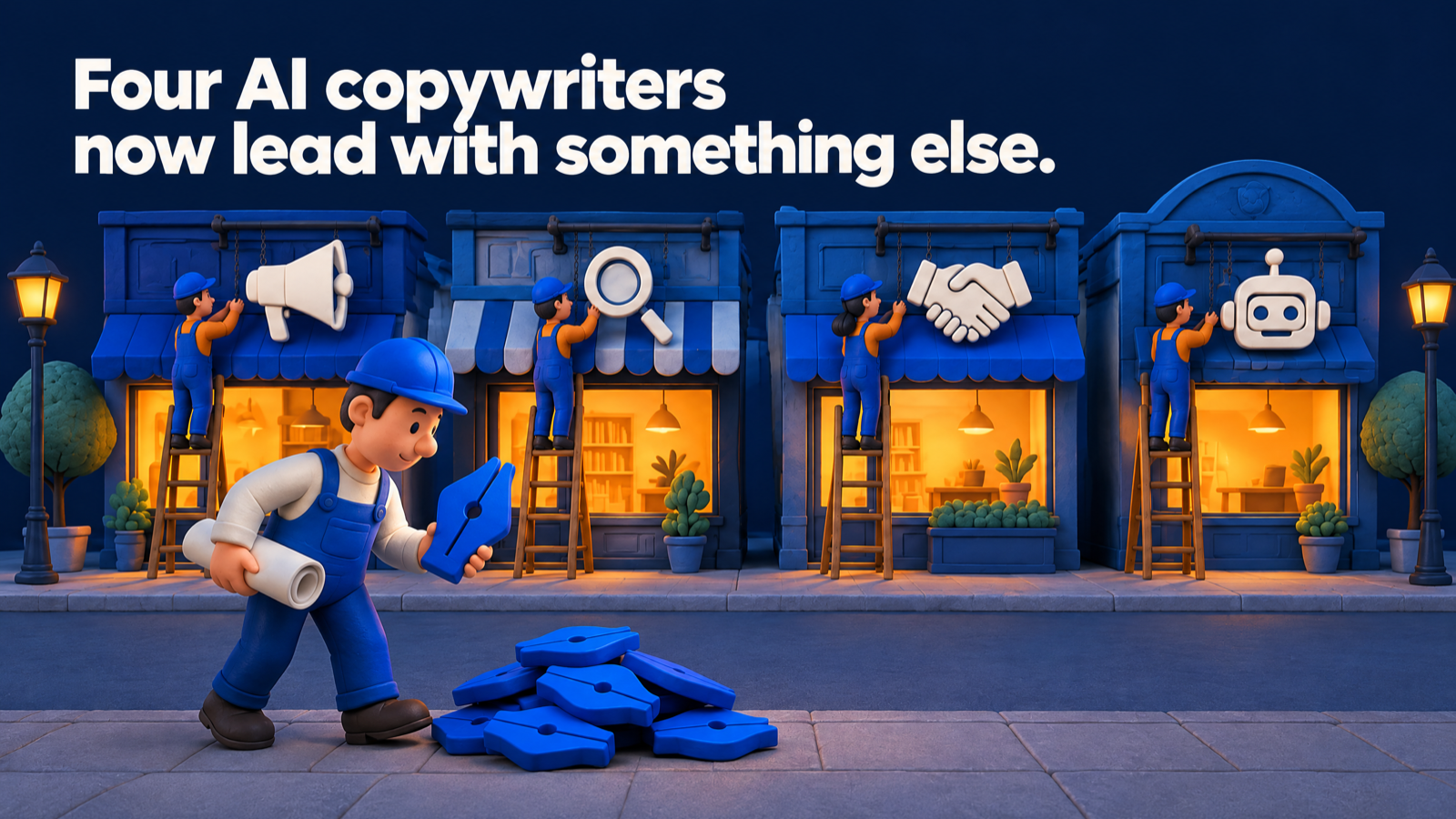
The AI copywriters now lead with something else

| Site | What its homepage leads with now | May 2026 visits | September 2026 visits | Change |
|---|---|---|---|---|
| Jasper | AI agents for marketing | 777,778 | 421,780 | −46% |
| Writesonic | Tracking what AI assistants say about a brand | 388,752 | 264,195 | −32% |
| Copy.ai | A sales and marketing platform | 514,399 | 404,173 | −21% |
| Rytr | An assistant that drafts client follow-ups | 185,458 | 182,402 | −2% |
We picked these four by name and read each homepage on November 19; none presents a writing tool as its main product. We did not read earlier versions of these homepages, so we cannot say when each changed. Jasper’s description reads “Orchestrate intelligent agents to run end-to-end marketing workflows”; a search listing still shows a copywriting page elsewhere on its site. Rytr still drafts messages, and its site ended about where it began.
Part of each fall may be a company walking away from that traffic, not losing it.
Most category and copywriter searches fell. On the summer median, “ai copywriting” went from 4,400 searches a month to 390 and “jasper ai” from 33,100 to 8,100. “ai copywriting” was at a two-year high in the summer of 2025, which is why the lead uses May. “grammar checker” fell least, and its September was higher than a year earlier: 1.22 million against 1 million.
What to check before you build a writing product
Where the writing happens. If your product is a box on a web page, the paraphrasers are your comparison. Ask five likely users where they last rewrote a paragraph. Nothing here shows where those visits went.
Whether Grammarly’s rise means demand. Its site ended September 5.8 million visits above May, up 11% to 59.8 million. The gain is entirely August to September: June, July and August were all below May. That fits the school and work calendar. Microsoft’s Word for the web fell 24% from May to August and ended 11% above May. Citation Machine lost more than half its visits over the summer and was back within 1% of May, though two other citation tools, EasyBib and BibMe, ended 12% and 25% below it. We cannot compare this September with last. About a quarter of Grammarly’s September figure is an address inside its site that first appears in our data in June; we could not check what it serves. And searches for “grammarly ai” fell 75% on the summer median.
What the big one bundles. Grammarly’s homepage lists a humanizer and an AI detector beside proofreading, and its owner’s suite includes GPTZero, whose market we covered earlier. A feature you plan to sell alone may already be bundled.
What grew, and how little to lean on it. Fifteen of the 59 gained visits, several of them only in September’s term-time rebound. Fiction tools, which we left out as a different product, mostly grew: seven of the 11 we read, among them DreamGen (up 62%), NovelAI (up 25%) and AutoCrit (up 12%), while Sudowrite lost 11%.
What moved last month. Our list of the fastest-growing AI writing companies is public and rebuilt monthly. When we checked on November 19 it showed August. It ranks by one month’s growth, so it shows small risers.
How we checked the numbers
We retrieved stored records from Night Watcher on November 19, 2026 and read 120 live homepages the same day.
A site qualified if it had at least 100,000 estimated visits in May or September 2026 and an estimate for every month between, if its homepage presents as its main product a tool that checks, rewrites or drafts everyday prose, in any language, and if its address did not change. Fifty-nine did: 20 grammar checkers and editors, 16 paraphrasers and 23 AI writers. These are the ones we could measure, classified by hand; the market is larger. The four former copywriters are not among them, and eleven more sites known for writing tools no longer lead with one (eight of those lost visits). Across the 59 the median change was −17%. Two of the 59 had under 20,000 visits in May and are read as new sites.
Left out, and growing: Sapling, a developer toolkit (up 17%); YouMind (up 26%) and Easy-Peasy (up 8%), which now sell general AI platforms; Paperguide, a research tool (up 34%); the tool collections Kiin (up 24%) and Word.Studio (up 22%); Granted AI, a grants database (up 63%); Grammar.com, a reference site (up 3%); Scalenut (up 41%) and Copymatic (up 38%), among others under the size rule; three adult story generators we did not read (up 34% to 71%); and Type.ai, which has no September estimate and was up 23% by August. GrammarCheck, a grammar checker with 1.85 million visits in September, has no May estimate. Writecream and one small paraphraser were level. Translators such as DeepL (down 16%), AI detectors and humanizers, research assistants and search-optimisation platforms are not counted. Notion and Editpad changed address. Scribbr has no September estimate.
superhuman.com rose 85%, but on July 8 the company announced it was turning Coda into Superhuman Docs and coda.io lost 87%. Together the two rose 8%. We read that as pages changing address, and count neither. QuillBot and Grammarly are measured as whole domains, which carry large blogs.
All traffic figures are estimates of visits to a website from every source. They are not users, subscribers, customers or revenue, and they leave out extensions, keyboards and apps. Same-size comparisons use the sites we track, grouped by their May visits. Search figures are rounded monthly estimates for the United States. We hold no history for “grammarly” or “quillbot” alone, only for longer phrases such as “grammarly ai”.
Jordan Cole
Creator of NightWatcher AI. Specializes in data-driven insights for AI product development, market validation, and competitive analysis.