When school came back, so did Quizlet. Ten of 11 AI homework sites came back smaller.
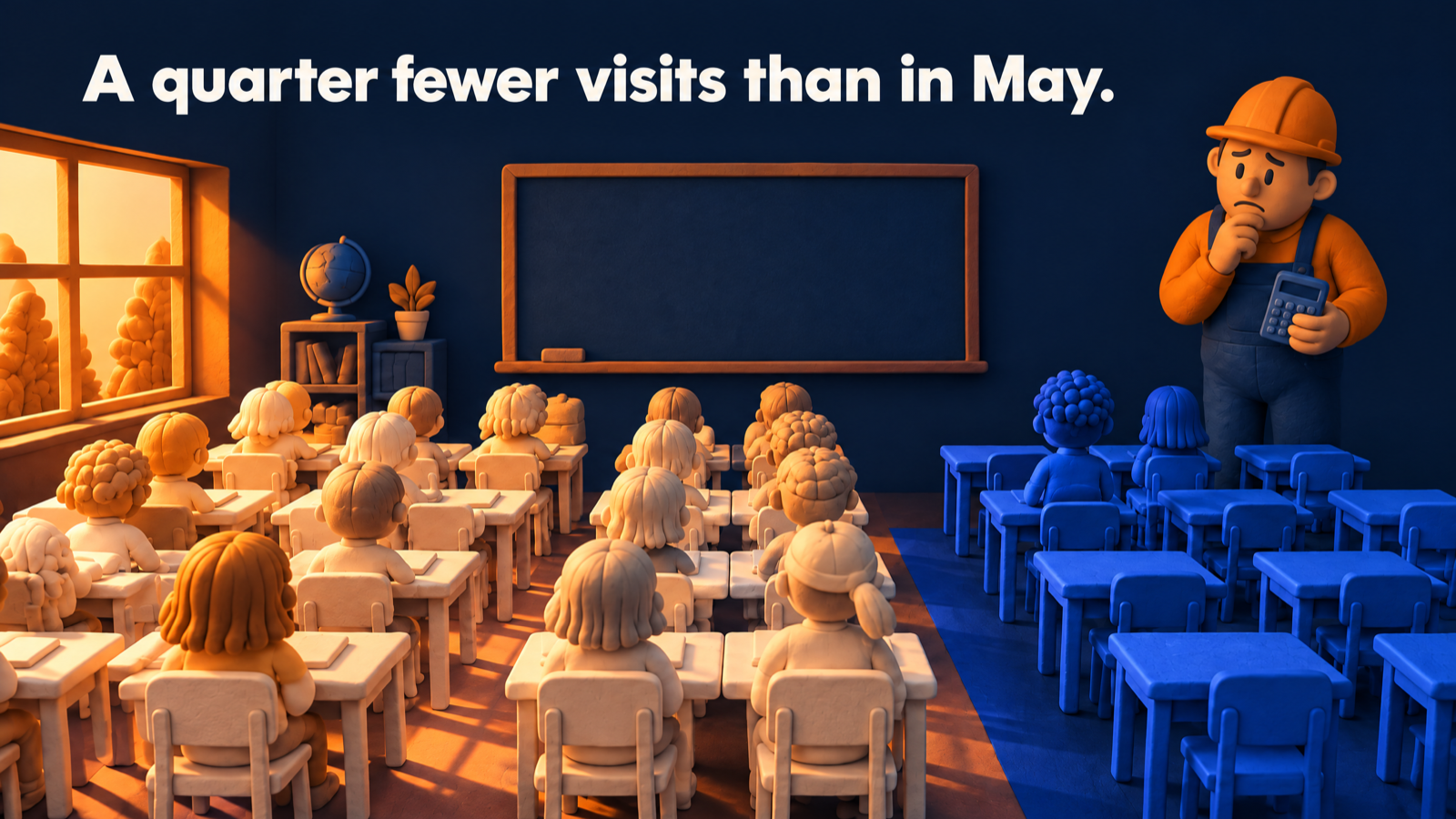
Quizlet’s estimated visits ended September 2026 4% above May. Ten of 11 AI homework-answer sites ended below May, though nine of those ten rose from August.
Table of Contents
When the 2026 school year started in the United States, Quizlet came back: its estimated visits in September 2026 were 4% above May. Ten of the 11 AI homework-answer sites we could measure came back smaller, with fewer estimated visits in September than in May, the typical site in the group 25% fewer. Nine of those ten rose from August to September like other school sites, just not back to May: Gauth’s main site ended 29% below it (27% across its addresses), StudyX’s 34% and math-gpt.org’s 44%. Chegg ended 4% below May. The typical AI tool for teachers ended 23% up, less than the 37% for ordinary classroom software.
Our data ends in September 2026. This is the start of the school year, not this month.
Quizlet, Chegg and classroom software are our yardsticks. They are far larger sites, and large sites move less: the median site we track lost 3% at 10 million visits or more and 14% at 100,000 to 1 million.
At least five of the 11, Gauth and Solvely among them, send visitors to a phone app, and website visits miss apps. A fall on the web does not show a fall in use.
The Verge, citing The New York Times, reported on November 18 that school systems in New York, Los Angeles and Chicago are considering alternatives to Google Search, after Google said schools that switch off its AI features will lose Search from next year, well after our data ends.
The homework-answer sites came back smaller

School sites sink in summer, so the test is how far each line came back. In July the typical homework-answer site had 55% of its May visits, about the same as classroom software at 52%. From August to September the typical classroom-software site gained 70%, the typical AI teacher tool 57%, the typical homework-answer site 37% and the typical older study site 24%. The median site of any kind that we track lost 3% that month.
Nine of the 11 homework-answer sites also did worse from May to September than the median site their size of any kind, a comparison that flatters sites a class is assigned, though not ones crammed with in May.
The exception is Solvely, up 126% to 1.93 million estimated visits. In our September snapshot 68% of its visits came from paid search ads. No other site in the five groups was above 12%.
It is not every AI tool for students. AI study tools, which turn a student’s own notes into flashcards and quizzes, split seven up and seven down. Gizmo rose 46%, to 7.8 million.
Three other readings fit the same figures. Apps: use may have moved off the web. Searches for “gauth ai” were 22% higher in September than in May while its site was lower. Exams: May is exam season, so a cramming tool can be higher in May in any year. United States search phrases are mixed on that: “ai homework helper” was 49% higher in September than in May in 2025 and level in 2026, but “homework answers” more than doubled between the two months in both years. Chat assistants: homework may have moved to them, and we cannot test it.
Teacher tools split, and September flatters them

Nine of the 15 AI tools for teachers ended above May and six below. MagicSchool, the largest, went from 2.24 million estimated visits to 2.75 million, up 23%. Chalkie rose 54% and Brisk 58%. Eduaide fell 53%, Edcafe 45% and Teachy 24%. Teachy’s educators are “in Brazil and worldwide”, its homepage says, so another calendar may apply.
Ordinary classroom software did better over the same months, 37% at the median: Instructure, which hosts schools’ Canvas sites, rose 67% and PowerSchool 29%. Both medians come from small groups, and six of the 15 teacher tools beat 37%.
United States searches for “magicschool ai” were about 50% higher in September than in May in both 2025 and 2026. The typical month of July to September was 55% lower in 2026 than in 2025, 201,000 against 450,000, and “ai for teachers” fell from 6,600 to 3,600. People may now type the name alone, and we hold no history for that. Searches for “chalkie” went the other way, from 2,900 to 40,500.
| Group | Sites | Above May | Below May | Typical change, May to September | Typical change, August to September |
|---|---|---|---|---|---|
| Classroom software | 11 | 10 | 1 | +37% | +70% |
| AI tools for teachers | 15 | 9 | 6 | +23% | +57% |
| AI study tools | 14 | 7 | 7 | −1% | +25% |
| Older study sites | 8 | 3 | 5 | −4% | +24% |
| AI homework-answer tools | 11 | 1 | 10 | −25% | +37% |
What to check before you build for schools
Who picks it, and who uses it. The groups that ended above May are ones a teacher or school puts in front of a class. The group furthest below is one a student opens alone to get an answer. In our September snapshot the typical classroom-software site got 61% of its visits direct, the typical AI teacher tool 49% and the typical homework-answer site 35%. Older study sites also got 35% and came back, so direct visits alone do not explain the gap. Still, ask it first: is your buyer a teacher or a district, and does the student arrive because they were told to?
Judge a school product September against September. Our list of the fastest-growing AI education companies is public and rebuilt monthly. When we checked on November 19 it showed August, when most school sites in our groups had started climbing, so read its growth figures with the calendar in mind.
If you sell to schools, September will flatter you. If you sell answers to students, find out what brings one back when nobody assigned it.
How we checked the numbers
We retrieved stored records from Night Watcher on November 19, 2026 and read each grouped site’s live homepage the same day, with two exceptions: Question.AI’s and Chegg’s pages would not load for us, so they rest on our stored descriptions.
An AI tool qualified with at least 100,000 estimated visits in May or September 2026 and an estimate for both months. The two yardstick groups, older study sites and classroom software, needed 1 million. We looked up 420 addresses that we listed by hand and hold 208 of them. These are the ones we could measure, classified by hand. They are not every school tool.
Left out for want of a September estimate: SchoolAI, Class Companion, Brainly, Mathway, Knowt and Kira, a teacher tool whose estimate went from 98,000 in May to 1.46 million in August. Brainly and Mathway are large older homework-answer sites, so the older-study yardstick is mostly flashcard, notes and reference sites. Symbolab has no May estimate. Diffit and Curipod are not in our data. Khanmigo, down 30%, is sold to learners and teachers alike and also lives on Khan Academy’s site. ClassPoint, down 21%, an older PowerPoint add-in, and Mote, down 11%, a reading and writing aid, are not counted as AI tools for teachers. Mathos changed address and fell 28% across both. Gauth has a second address that had no visits in May; across its three addresses it fell 27%.
Four homework-help sites are left out because they are not AI-first tools a student opens: Numerade, down 2%, an older video-solutions library that now leads with an AI tutor; Filo, down 31%, and Kunduz, up 1%, which mix human tutors or experts with AI; and Zuoyebang, down 9%, a Chinese app maker’s company site. Cymath, down 48%, would not load. Among sites under 100,000 visits, 11 of 19 teacher tools rose and 8 of 21 student tools did.
MagicSchool’s address also carries its student pages, which had 457,000 estimated visits in May. Photomath, down 19%, is an older app kept with the homework tools because its offer is the same, and Question.AI, down 28%, is counted on its stored description.
“Typical” means the median site in a group, not weighted by size. All traffic figures are estimates of visits to a website from every source and every country. They are not users, students, teachers, downloads or revenue, and they leave out apps and browser extensions. Search figures are rounded monthly estimates for the United States.
Jordan Cole
Creator of NightWatcher AI. Specializes in data-driven insights for AI product development, market validation, and competitive analysis.